
Consumer Price Index in February 2026
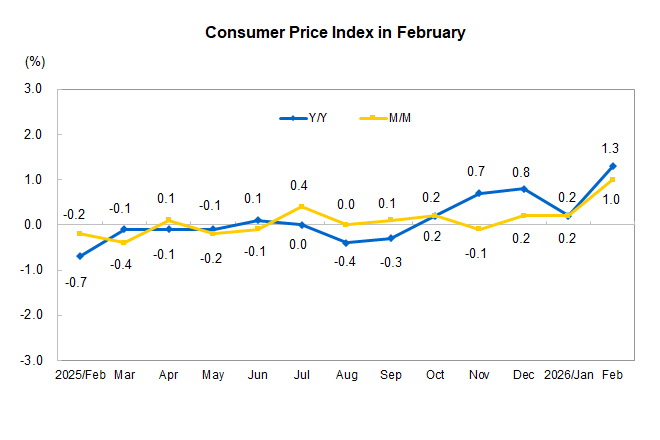
In February 2026, China’s Consumer Price Index (CPI) increased by 1.3% year on year. Specifically, the price index in urban areas increased by 1.4% while that in rural areas increased by 0.9%; the price index for food increased by 1.7% while that for non-food increased by 1.3%; the price index for consumer goods increased by 1.1% while that for services increased by 1.6%. From January to February, on average, China’s CPI increased by 0.8% year on year.
In February, China’s CPI increased by 1.0% month on month. Specifically, the price index in urban areas increased by 1.0% while that in rural areas increased by 0.7%; the price index for food increased by 1.9% while that for non-food increased by 0.8%; the price index for consumer goods increased by 0.8% while that for services increased by 1.1%.
I. Year-on-Year Changes in Price Indexes for Various Goods and Services
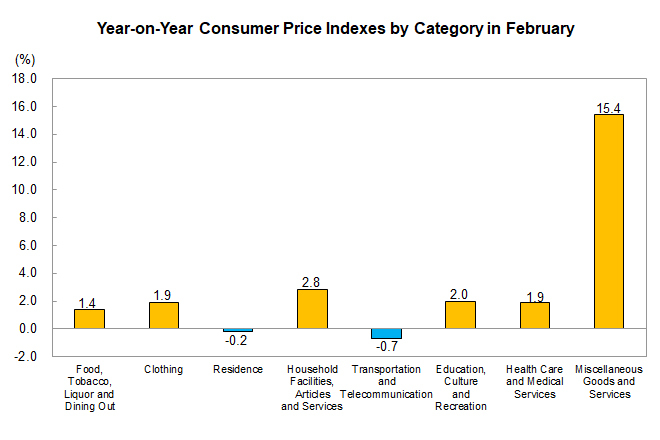
In February, the price index for food, tobacco, liquor and dining out increased by 1.4% year on year, pushing the CPI up by about 0.41 percentage points. Among food, the price index for fresh vegetables increased by 10.9%, pushing the CPI up by about 0.19 percentage points; that for aquatic products increased by 6.1%, pushing the CPI up by about 0.11 percentage points; that for fresh fruits increased by 5.9%, pushing the CPI up by about 0.12 percentage points; that for eggs decreased by 2.9%, pushing the CPI down by about 0.02 percentage points; that for meat decreased by 2.7%, pushing the CPI down by about 0.11 percentage points, of which the price index for pork decreased by 8.6%, pushing the CPI down by about 0.17 percentage points.
Among the price indexes for the other seven major categories, five increased, and two decreased year on year. Specifically, the price indexes for miscellaneous goods and services, household facilities, articles and services and education, culture and recreation increased by 15.4%, 2.8% and 2.0%, respectively; the price indexes for clothing, and health care and medical services both increased by 1.9%; and those for transportation and telecommunication, and residence decreased by 0.7% and 0.2%, respectively.
II. Month-on-Month Changes in Price Indexes for Various Goods and Services
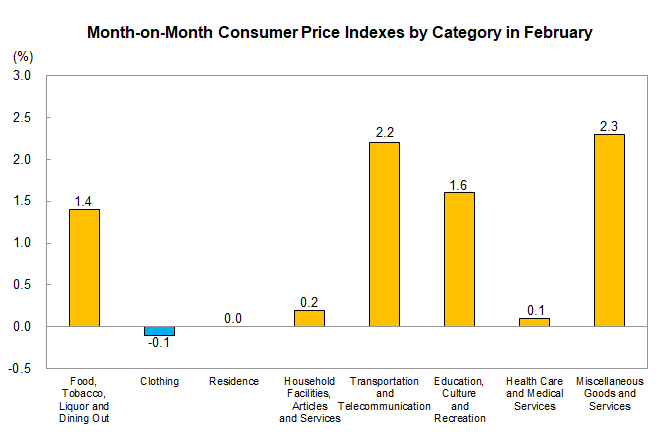
In February, the price index for food, tobacco, liquor and dining out increased by 1.4% month on month, pushing the CPI up by about 0.40 percentage points. Among food, the price index for aquatic products increased by 6.9%, pushing the CPI up by about 0.13 percentage points; that for fresh fruits increased by 4.0%, pushing the CPI up by about 0.08 percentage points; that for meat increased by 2.6%, pushing the CPI up by about 0.11 percentage points, of which the price index for pork increased by 4.0%, pushing the CPI up by about 0.07 percentage points; that for eggs increased by 1.3%, pushing the CPI up by about 0.01 percentage points.
Among the price indexes for the other seven major categories, five increased, one remained flat, and one decreased month on month. Specifically, the price indexes for miscellaneous goods and services, transportation and telecommunication and education, culture and recreation increased by 2.3%, 2.2% and 1.6%, respectively; the price indexes for household facilities, articles and services, and health care and medical services increased by 0.2% and 0.1%, respectively; that for residence remained flat; and that for clothing decreased by 0.1%.
Consumer Price Indexes in February 2026
|
|
Growth Rate M/M (%) |
Growth Rate Y/Y (%) |
Jan-Feb Growth Rate Y/Y (%) |
|
Consumer Price Index |
1.0 |
1.3 |
0.8 |
|
Of which: Urban |
1.0 |
1.4 |
0.8 |
|
Rural |
0.7 |
0.9 |
0.5 |
|
Of which: Food |
1.9 |
1.7 |
0.5 |
|
Non-food |
0.8 |
1.3 |
0.8 |
|
Of which: Consumer goods |
0.8 |
1.1 |
0.7 |
|
Services |
1.1 |
1.6 |
0.8 |
|
Of which: Excluding food and energy |
0.7 |
1.8 |
1.3 |
|
By category |
|
|
|
|
I. Food, tobacco, liquor and dining out |
1.4 |
1.4 |
0.6 |
|
Grain |
-0.2 |
-0.4 |
-0.2 |
|
Edible oil and fats |
-0.4 |
-1.1 |
-0.9 |
|
Fresh vegetables |
-0.1 |
10.9 |
8.8 |
|
Meat of livestock |
2.6 |
-2.7 |
-4.4 |
|
Of which: Pork |
4.0 |
-8.6 |
-11.2 |
|
Beef |
1.8 |
9.6 |
8.4 |
|
Mutton |
2.2 |
6.6 |
5.6 |
|
Aquatic products |
6.9 |
6.1 |
3.4 |
|
Eggs |
1.3 |
-2.9 |
-6.2 |
|
Milk and other dairy products |
-0.4 |
-1.1 |
-1.0 |
|
Fresh fruits |
4.0 |
5.9 |
4.5 |
|
Cigarettes |
-0.1 |
-0.3 |
-0.3 |
|
Liquor |
-1.1 |
-2.6 |
-2.2 |
|
II. Clothing |
-0.1 |
1.9 |
1.9 |
|
Garments |
-0.2 |
2.0 |
2.0 |
|
Footwear |
0.1 |
1.4 |
1.4 |
|
III. Residence |
0.0 |
-0.2 |
-0.1 |
|
Rent of rental housing |
-0.1 |
-0.5 |
-0.4 |
|
Water, electricity and fuels |
0.0 |
0.4 |
0.4 |
|
IV. Household facilities, articles and services |
0.2 |
2.8 |
2.7 |
|
Home appliances |
-1.1 |
5.3 |
6.0 |
|
Household services |
1.7 |
3.8 |
0.7 |
|
V. Transportation and telecommunication |
2.2 |
-0.7 |
-2.1 |
|
Automobiles |
0.1 |
-1.2 |
-1.3 |
|
Energy for transport facilities |
2.8 |
-9.0 |
-9.7 |
|
Use and maintenance of transport facilities |
3.6 |
3.7 |
1.5 |
|
Communication facilities |
0.1 |
1.9 |
1.6 |
|
Telecommunication services |
0.0 |
0.0 |
0.0 |
|
Postal services |
0.2 |
0.3 |
-0.7 |
|
VI. Education, culture and recreation |
1.6 |
2.0 |
1.0 |
|
Education services |
0.0 |
0.5 |
0.5 |
|
Travel agencies and other touring services |
14.1 |
11.7 |
2.3 |
|
VII. Health care and medical services |
0.1 |
1.9 |
1.8 |
|
Traditional Chinese medicines |
-0.1 |
-1.4 |
-1.4 |
|
Western medicines |
-0.1 |
-1.0 |
-1.0 |
|
Medical services |
0.1 |
2.8 |
2.7 |
|
VIII. Miscellaneous goods and services |
2.3 |
15.4 |
14.3 |
Annotations:
1. Index Interpretation
The Consumer Price Index (CPI) is an indicator that measures relative changes in the price level of consumer goods and services over time. It comprehensively reflects changes in prices of consumer goods and services purchased by residents.
2. Statistical Coverage
The CPI statistical survey covers the prices of eight major categories of goods and services purchased by national urban and rural residents, including food, tobacco, liquor and dining out, clothing, residence, household facilities, articles and services, transportation and telecommunication, education, culture and recreation, health care and medical services, and miscellaneous goods and services, as well as 268 basic categories.
3. Survey Method
Survey sites are selected using a sampling method. In accordance with the principle of “fixed person, fixed site, and fixed time”, original prices are collected either through on-site visits to the survey sites or from online sources. The data comes from nearly 120,000 survey sites in about 500 cities and counties in 31 provinces (autonomous regions and municipalities), covering shopping malls (stores), supermarkets, farmers’ (fresh produce) markets, service outlets, and Internet e-commerce.
4. Data Description
Due to rounding, the aggregate data may be equal to the high or low value of the classified figures.
5. Base Period Rotation
According to the statistical system arrangement, China’s CPI undergoes a base period rotation every five years. Starting from January 2026, the CPI will be compiled and published with 2025 as the base period. Compared with the previous base period, the survey categories, representative specification items, surveyed sites, and the category weights have been adjusted to reflect the latest changes in the consumption structure. According to calculations, the impact of the base period rotation on the monthly year-on-year CPI is approximately 0.06 percentage points on average.